Who Am I, and Whose Am I?
Who Am I, and Whose Am I?
Psychologists and philosophers often note that human stability hinges on a person’s ability to answer two fundamental questions: Who am I? and Whose am I? The first demands a definition of our individual character; the second demands a declaration of our belonging.
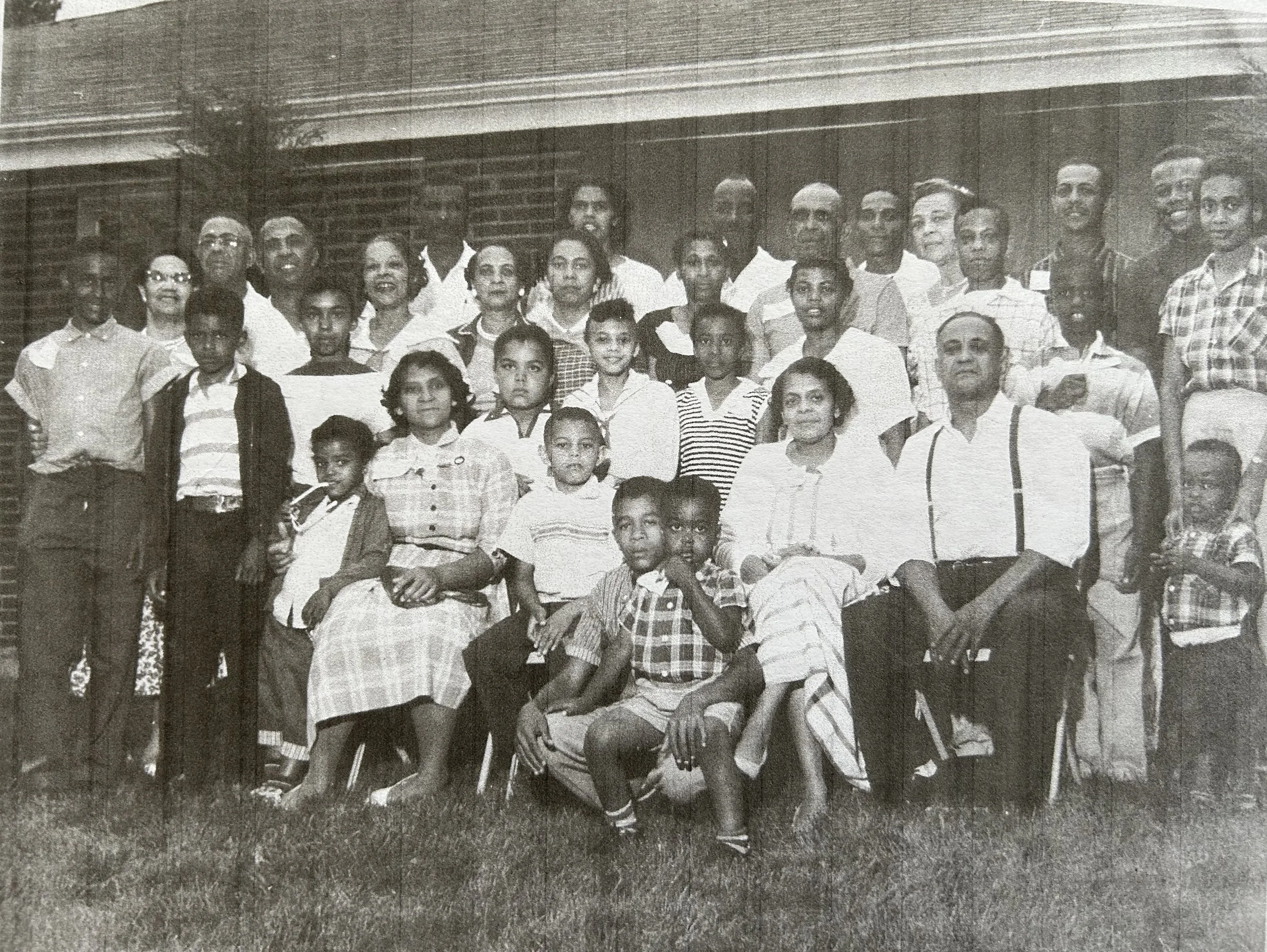
In our modern world, people fracture themselves trying to answer these questions in isolation. We are told that we belong only to ourselves, and that identity is something we must manufacture out of thin air. But when I look at an old, black-and-white photograph of our family hanging on my wall, I am reminded that our people were spared this exhausting, modern anxiety.
There are no casual, practiced smiles for the camera in that frame. Instead, there is an unmistakable, heavy seriousness in their faces. It is as if, in the brief moment the shutter clicked, they fully understood that decades later, their descendants would be standing in a chaotic, adrift world, looking back at that image for answers. They stared into the lens with the quiet certainty of people who already knew exactly who they were, and precisely whose they were. They were anchoring a lineage.
For me, the weight of that legacy became entirely real on the days my own children were born. One of the most profoundly consequential acts a father will ever perform is the simple, deliberate gesture of assigning a family name to his newborn child. I remember those moments with absolute clarity because it was my way of claiming them. By giving them our name, I was officially bringing them under a covering, placing them beneath a canopy of multi-generational protection, provision, and history.
As a child, you have no inkling of what this means. You cannot comprehend that the name on your birth certificate grants you immediate title to an identity and a shelter that you did absolutely nothing to earn. You are simply handed the baseline security of what came before you. But an unearned inheritance always carries a silent accountability. While a child is entitled to the protection of the family name, they are also entirely responsible for how they wear and represent it. It is a loan of legacy.
“The ultimate metric of a life well-lived within a clan is a sobering one: when you finally lay that name down at the end of your days, did you leave it better or worse than it was when you acquired it?”
While a child is entitled to the protection of the family name, they are also entirely responsible for how they wear and represent it. It is a loan of legacy, and that accountability governs us from birth to our final days.
Answering "Whose Am I?": The Architecture of a Clan
To answer the question of whose we are, we have to look to the bedrock of Howard County, Indiana, where our family was legally and culturally incorporated. Our belonging was forged through a crucible of love, sudden loss, and absolute resilience, driven by ancestors who possessed a singular, unyielding hunger for progress.
Consider Grandfather Richard Cunningham. Born into slavery, he attributed his deep love of learning to his mother, Ellen Richardson, who taught him early on that there was a correct way to do every single job. When Ellen and the rest of his family were sold away to another plantation, Richard remained behind until the Emancipation Proclamation. Forbidden from looking into books as a boy, his hunger for education grew so strong that after the war, he crossed the state line into Indiana and sat in schoolrooms beside small children until he mastered the three R's.
The dates tell the structural story of how that resilience was codified. On May 14, 1876, Charles Edward Reed, Jr. was born to Charles Reed, Sr. and Mary Finley. Tragically, Charles Sr. passed away before his son's first birthday. Left a young widow, Mary Finley married Richard Cunningham on December 27, 1877. This second union was far more than a conventional remarriage; it was a multi-generational incorporation. It bound the Reed and Cunningham names into a single, cohesive unit, raising Charley Reed, Jr. alongside his twelve younger brothers and sisters on a farm southwest of Kokomo, near New London.
Surrounded by our neighbors, "The Friends," who were Quakers, our ancestors established a lifestyle rooted in deep mutual reliance. While Grandfather Richard expanded his tile and brick factory, even carrying his workers on credit during the economic Panic of 1889 to build bricks for his own barn, Grandmother Mary maintained an immaculate, structured household. She ensured that every family member had their chores, their school clothes, and an uncompromised "Sunday best" hidden neatly over the feather ticks.
When winter snows blanketed the fences of School District #6, Richard would walk ahead to break the path, followed closely by Charley, Martha Elizabeth "Mattie," and Joseph Alexander. They depended on one another to survive and thrive. When segments of the family eventually migrated, they didn't leave that tight-knit culture behind in the dirt. They packed it up and carried it with them. To be a Reed-Cunningham means that your identity is nested within a collective. You belong to a fortress.
Answering "Who Am I?": The High Value of the Salt
If history answers whose we are, our historical utility answers who we are. We have long defined ourselves by a scriptural standard: we are the "salt of the earth."
Today, that phrase is tossed around as a casual compliment for anyone who is folksy or polite. But historically, salt was a high-stakes asset of absolute survival. Empires rose and fell by its trade routes, and brutal wars were fought exclusively to control it. Long before modern refrigeration, salt was the singular, non-negotiable barrier between preservation and decay. More than that, it was the engine of human progress. Without salted provisions, world travel and global exploration were impossible; ships could not cross oceans, and pioneers could not survive the frontier without it.
To be the salt of the earth means you are foundational, preserving, and entirely useful to the people around you. That is exactly who we have been across every coordinate of our family tree, as our ancestors consistently broke barriers to build structural and institutional stability.
We see it in Martha "Mattie" Cunningham and her brother Joseph Alexander Cunningham, who became the very first Black students to enroll in and graduate from Manchester College. Mattie graduated in 1903 with a dual degree in Bible and English, eventually becoming the first woman ordained and installed as a minister in the Church of the Brethren. She went on to marry Wiley Newton Dolby, a licensed engineer employed by Wilberforce College, in a magnificent 1907 wedding at the family farm. Her brother Joseph graduated in 1906, moved to Chicago, and went on to medical school to become a deeply respected physician, known affectionately to all of us as "Uncle Doc."
We see it in Charley Reed, Jr., who married Sophia Woods at 17, established his own farm east of New London, and built a successful house-moving and foundation contracting business, transforming his operation from the traditional strength of mules to full mechanization.
The Industrial Frontier and the Great Migration
The family's move to Michigan was an intentional extension of these established lines. Around 1942, Pearl and Geraldine Reed moved their family to Michigan to join the industrial manufacturing boom. They followed a reliable path cleared by Pearl’s older brother, John Reed, who, along with his wife Hazel, had successfully established themselves in the area after John returned from serving in World War I.
Sociological researchers document this era as the peak of the Second Great Migration. During the 1940s, more than 1.5 million African Americans fled the economic restrictions of the South and rural Midwest for defense industry hubs. Ypsilanti became a critical national epicenter of this movement when the Ford Motor Company constructed the massive 3.5-million-square-foot Willow Run Bomber Plant to mass-produce B-24 Liberator aircraft. The sudden population explosion of over 42,000 workers entirely reshaped the county, resulting in landmark structural milestones like Parkridge Homes. Built in 1943 by pioneering Black architect Hilyard Robinson, Parkridge was specifically designed to house the influx of African American defense workers, providing the community with its own townhomes, yards, and civic spaces.
It was in this rich, industrial landscape that the family's alliances grew. Pearl and Geraldine Reed's daughter, Aunt Linda, married Uncle France Edward Holmes, who came from a long line of preachers in Ozark, Alabama. Together, Aunt Linda and Uncle Eddie established the Word of Deliverance Church, becoming an unshakeable pillar in the Willow Run area. Aunt Phyllis Reed married Uncle Richard Williams, anchoring themselves as enduring pillars within Ypsilanti’s 1st Ward. They joined a legacy already started by my grandparents, James Reed and M. Celia Bow; the Bow family was one of the oldest and most established Black families in Ypsilanti, having migrated from Maine through Canada to build historic homes and establish the foundations for the first AME Church and Second Baptist Church.
Even down to our present generation, this legacy of civic preservation manifests in public leaders like State Representative Ronnie Peterson and his wife, Gloria Reed, who continues to guide the community as a current Trustee on the Ypsilanti Township Board of Trustees. Our family has been the founding force, the financial support, and the leadership behind the infrastructure of our neighborhoods up until the present day. That is who we are: we are the preservers. We are the salt.
“The most radical thing a man can do in a culture of fleeting attachments is to build an unshakeable family fortress—a lineage where children never have to wander the world searching for an identity, because their inheritance was secured before their first breath.”
Guarding the Answers for the Next Generation
But the warning of history is unyielding: salt can only preserve if it retains its purity. If it is diluted by elements that slowly wash its character away, it becomes useless.
Our family has thrived across centuries because we understood that the answers to who we are and whose we are depend entirely on the partners we choose to bring into the circle. Our historic marriages were not just temporary, private romances; they were purposeful mergers. We joined ourselves with families—like the Dolbys, the Radcliffs, the Bows, the Holmeses, and the Williamses—who already answered those two existential questions the exact same way we did. When Uncle Doc brought his wife, Blanche Radcliff, to Chicago, her home became the universal welcoming beacon and sanctuary for every family member migrating to the city. These individuals brought their own strength to the family wall rather than leaning on it until it cracked.
Choosing a spouse is the most radical, consequential act of identity any of us will ever commit, because that choice dictates exactly who and whose our children will be. It is the art of good selection. Bringing an asset into the clan reinforces the fortress; bringing in a liability introduces a quiet rot that can bring generations of building crashing down. We must actively guard against that.
This is why our elders cannot afford to sit silently on the sidelines of modern culture. Those who have walked the road have the vantage point of the horizon. They can see past temporary infatuation. Our elders must take an active, guiding role in counseling the next generation—helping them look for alignment in character, faith, endurance, and values before the perimeter is breached.
The Choice Before Us
Which brings me back to the serious, unblinking faces in that old photograph on my wall. They knew who they were, and they knew exactly whose they were.
Now, the baton is in our hands, and the lens of history is focused on us. As we have grown larger, more comfortable, and more scattered across the map, do we still know the answers? Are we still protecting what makes us slightly different? Are we still producing men and women who are useful to others beyond themselves, or have we begun to trade in our unique inheritance just to blend in with a disconnected world?
The foundation is poured, and it is magnificent. But a clan is only as strong as its living branches. Let us choose to build wisely, let us choose our partners with reverence for our past, and let us ensure that when the next generation asks who and whose they are, their answer will remain the Reed-Cunningham family.