We Were Raised to Become a Family
We Were Raised to Become a Family
What the Kokomo reunions once taught us—and how we must recover the offices of husband, wife, father, and mother in an age of individualistic drift.
In many Black households, there is an unwritten grammar that every child learns long before they can articulate it: a profound difference exists between saying someone “fixed dinner” and saying someone “cooked dinner.” To fix dinner is an act of rapid transaction. A person can fix a cold bologna sandwich, heat a box of frozen dinners, or boil quick noodles to quiet a child's rumbling stomach. There is no shame in fixing dinner; it is an act of survival when mothers and fathers are working double shifts, nursing exhaustion, or stretching pennies before payday. But to cook dinner is an act of cultural formation. Cooking dinner requires selecting fresh ingredients, seasoning without measuring tapes, managing heat across multiple pots, stretching a broth so there is always enough for an unannounced cousin, and teaching a daughter or neice how to stand at the stove without burning the rice. To cook dinner is to transform a kitchen into a sanctuary of presence.
A similar distinction governs the back yard. There is a world of difference between a man who says he is going to “throw something on the grill” and a man who announces he is going to “smoke some meat.” Throwing burgers or hot dogs on a gas grill takes twenty minutes; it satisfies immediate hunger. But smoking meat is an event that demands an entire day. It requires fire management, wood selection, patience, seasoned rubs, and cold morning prep. More importantly, it requires a pit. Around that pit or smoker, older men gather. Younger men stand nearby, holding tongs or carrying wood, listening as the elders talk about marriages that survived hard winters, factory layoffs, bad financial choices, political shifts, and the quiet discipline required to remain a reliable father. The meat is not the only thing being cured over those slow-burning hickory coals; the younger men are being cured. They are learning what a man carries when the world outside the fence grows cold.
Fixing & Grilling
Solves immediate hunger. Driven by convenience, speed, and isolated consumption. People eat quickly, often looking at screens, consuming food without experiencing communion.
Cooking & Smoking
Forms human character. Requires patience, fire management, season, and presence. Creates a classroom where story, wisdom, discipline, and intergenerational duty are transmitted.
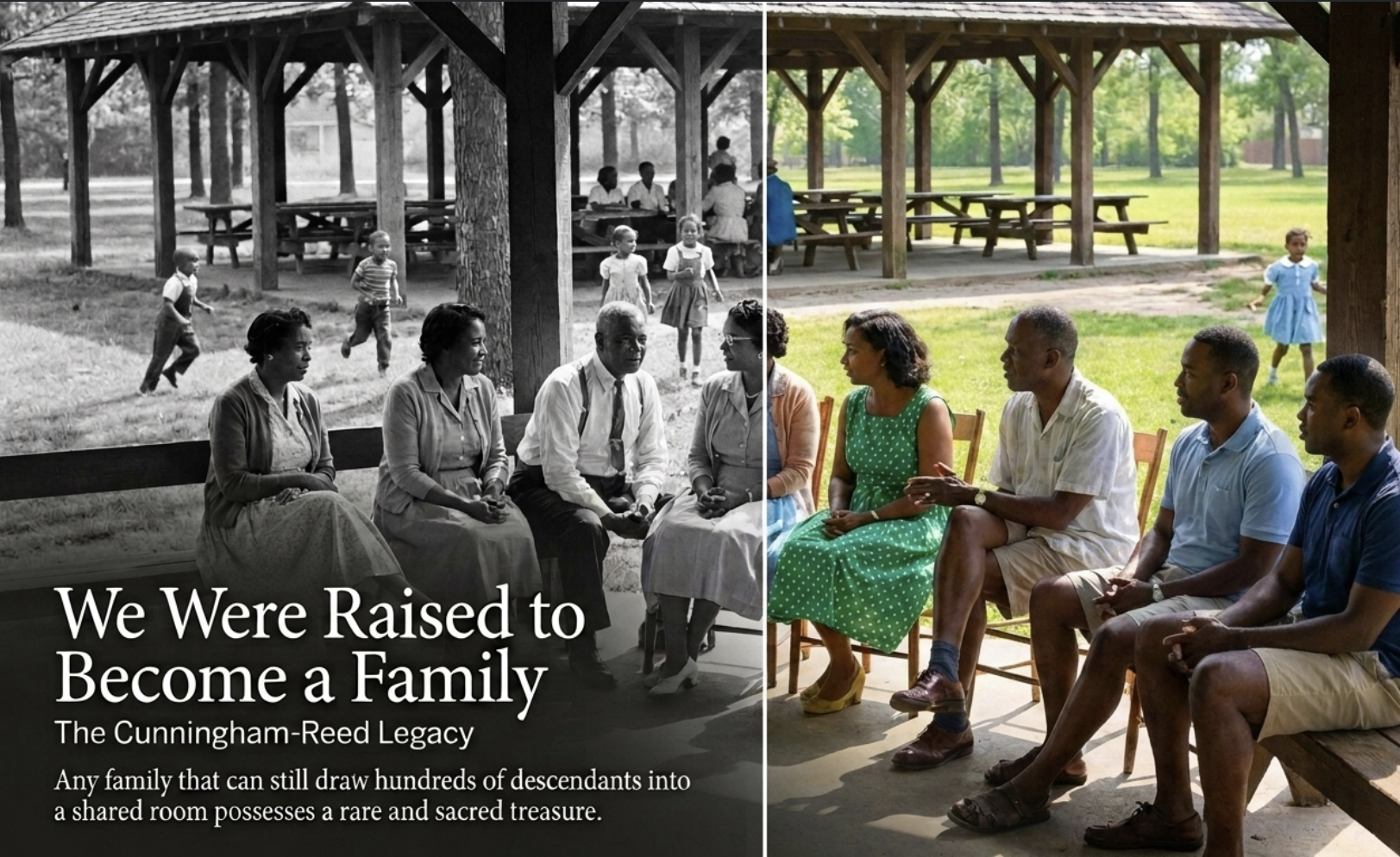
I thought about this difference during our most recent Cunningham-Reed family reunion. I was deeply grateful to see relatives -- grateful for the travel, the laughter, the photographs, and the effort it took for multiple generations to assemble under one roof. Any family that can still draw hundreds of descendants into a shared room possesses a rare and sacred treasure. Yet, alongside that gratitude, I felt a quiet, persistent heartbreak.
I looked around the room and saw young men and women whom I love dearly, yet many appeared to be living without the structural scaffolding, moral formation, and inherited blueprint necessary to build durable families of their own. I saw small children huddled tightly around their individual parents rather than running freely in packs with their cousins. I saw relatives occupying the exact same square footage without experiencing themselves as part of one living body. In our eagerness to keep the energy high, we inadvertently created an environment where conversation was nearly impossible—unwittingly crowding out the quiet spaces where story, history, correction, and wisdom are usually passed from the old to the young. We were in the same room, but I wondered whether we were truly gathering or whether we were simply fixing a party when we should have been cooking a family.
The Classroom Without Desks
I remember earlier Cunningham-Reed family reunions in Kokomo, Indiana. I remember the open parks, the shaded shelters, and the feeling that the perimeter of the park was guarded by an invisible wall of aunts, uncles, and elders. Children ran wild with cousins they only saw once or twice a year, yet we felt completely safe because the entire family formed our protective boundary. We were not isolated households sharing a picnic table; we belonged to a family clan.
In front of the large fireplace, the elders sat in chairs, catching up on life. They talked about marriages, factory shifts, church politics, local politics, economic downturns, and relatives long buried. They quietly introduced us to a history we had not lived. We did not realize it at the time, but those reunions were not mere entertainment. The reunion was a classroom without desks. It was where cousins became allies, where elders were treated as living archives, and where young people watched husbands, wives, fathers, and mothers fulfill recognizable, honorable roles.
When relatives ask why I spend hundreds of hours digging through census records, land deeds, and marriage certificates to record our family history, my answer is simple: I am researching our past because we are beginning to forget who we are.
Genealogy is often reduced to a quiet hobby of collecting names, dates, and gravestone photographs. But for us, it is a reclamation project. The Cunningham-Reed story did not begin with our generation. Our people were forged in the soil of Howard and Hamilton Counties in Indiana, living alongside Quaker communities, building self-sufficient farms, acquiring land, mastering trades, establishing churches, and building tight-knit networks of mutual aid. In 1942, key branches of our family migrated to Ypsilanti, Michigan, to claim industrial factory jobs, while others moved toward Chicago to enter the professions. Those migrations were not random address changes; they were strategic maneuvers by a family determined to secure economic advancement while carrying its moral identity intact.
"A family can gain income, professional titles, and material comfort while losing proximity to elders, shared work, inherited rituals, and the daily presence of extended kin. We can become more successful as individuals while becoming weaker as a family." Germar Reed
Raising People for Family Life
The greatest advantage our ancestors possessed was that they did not merely raise children to become self-sufficient individuals or high-earning corporate employees. They raised husbands and fathers. They raised wives and mothers.
In our modern conversation, that statement makes people uneasy. We live in a culture that has elevated individual professional status as the sole metric of human worth, while treating domestic commitment as an archaic compromise. But to say that we must raise wives and mothers is not to suggest that Black women should be voiceless, uneducated, or barred from professional achievement. My own daughters are being raised with rigorous academic expectations. They are being equipped to excel in whatever professional arena aligns with their intellect and gifts, whether as attorneys, executives, physicians, scientists, professors, or entrepreneurs.
However, professional capability is only a fraction of full human maturity. My wife and I are also intentionally teaching them the arts of household stewardship, caregiving, marital partnership, hospitality, family finance, conflict resolution, child development, and intergenerational duty. We are raising the potential future mothers of our grandchildren. A woman who builds a stable, loving household, supports a durable marriage, preserves family culture, and forms the moral character of the next generation is performing labor that no corporate title or six-figure salary can match. An executive manages an organization for a season; a wise mother shapes descendants she will never live to see.
Likewise, if we are raising sons, we cannot be satisfied with merely producing males who can earn a paycheck, buy nice cars, attract women, or father children. We must raise husbands and fathers...men who understand that male authority is not rooted in bluster or domination, but in provision, physical protection, fidelity, emotional maturity, discipline, and self-sacrifice. Fatherhood is not biology. Motherhood is not childbirth. Marriage is not romance. They are sacred offices of responsibility that require deliberate preparation.
Our family was historically anchored by what I call a quiet patriarchal structure paired with a deep, resilient maternal baseline. Men carried heavy weight; they were expected to remain, protect, provide, and answer for the condition of their homes. Black women demonstrated heroic strength in building networks of care, but we must never confuse a family's ability to survive a father's absence with proof that fatherhood is optional. A mother-centered structure built to compensate for male loss is an emergency rescue mechanism, not the structural ideal we should pass to our children.
Ritual vs. Entertainment: Reclaiming the Gathering
This brings us back to the core question: What is a family reunion actually for?
In recent years, the push has been toward making reunions more entertaining; louder sound systems, continuous games, travel destinations, and non-stop stimulation. There is a place for joy, dancing, and laughter; a reunion should never feel like a solemn lecture or a corporate audit. But entertainment cannot become the highest purpose of the gathering. We can buy entertainment anywhere. We can stream music, attend concerts, visit amusement parks, or scroll on our phones every hour of the day. What we cannot find anywhere else on Earth is the living memory of the Cunningham-Reed family.
When an elder passes away without having their stories recorded, a library burns to the ground. The loud music that prevents an uncle from explaining how our family survived the Great Depression or migrated from Indiana will not travel home with us. The rented decorations will not travel home. But the stories can. The covenants can. The names of the ancestors can. A young father who spends two hours sitting by the smoker with older men, learning how to steady his marriage during lean years, carries an asset home that will protect his children for thirty years.
"Traditions tells the individual that they exist inside a story that began long before their birth and will continue long after their death. Entertainment asks if you are having fun right now; ritual asks if you are participating in something worth preserving." The Cunningham-Reed Legacy
To restore our reunions to their original dignity, we must intentionally design them as rituals of renewal:
- Design Quiet Spaces for Conversation: Establish deliberate times and quiet zones where elders can sit, talk, tell stories, and be interviewed by younger generations.
- Display the Living Archive: Set up historical tables featuring labeled photographs, ancestral timelines, land records, and family trees so children learn their roots visually.
- Honor Marriage & Faithful Service: Publicly recognize long marriages, dedicated parents, community builders, entrepreneurs, and young people mastering skills.
- Cook Together: Move away from catering every meal. Keep space for shared preparation in the kitchen and around the smoker where embodied knowledge is passed down.
- Name the Fallen: Solemnly read the names of those who passed since the last gathering, reminding the living that we carry their mantle forward.
Becoming the Ancestors
One day, every person reading these words will be an ancestor. Our names will be line items on a family tree; our faces will look antique in old digital photos. Our descendants will gather in a room somewhere in Indiana, Michigan, Illinois, or beyond, and they will talk about the choices we made in this era.
What will they say about us? Will they say that we saw our family structure fragmenting and remained silent out of fear of offending someone? Will they say that we inherited rich stories and lost them to convenience? Will they say we became educated, titled, prosperous, and entertained, but forgot how to build durable homes?
Or will they say that our generation looked at the drift, called a halt to the noise, and chose to rebuild? Will they say we sat at the feet of our elders, honored our wives, held our men accountable, raised our children for family offices, cooked meals with patience, and smoked meat around fires where wisdom was passed down?
The Cunningham-Reed family is not merely a list of people who share blood. It is an inheritance. It is an office of responsibility. It is a fortress that must be rebuilt in every single generation. Let us enjoy our reunions—let us laugh, dance, eat, and take our photos. But let us also sit down. Let us call the children closer. And let us make sure that when we leave the room, we take the family home with us.